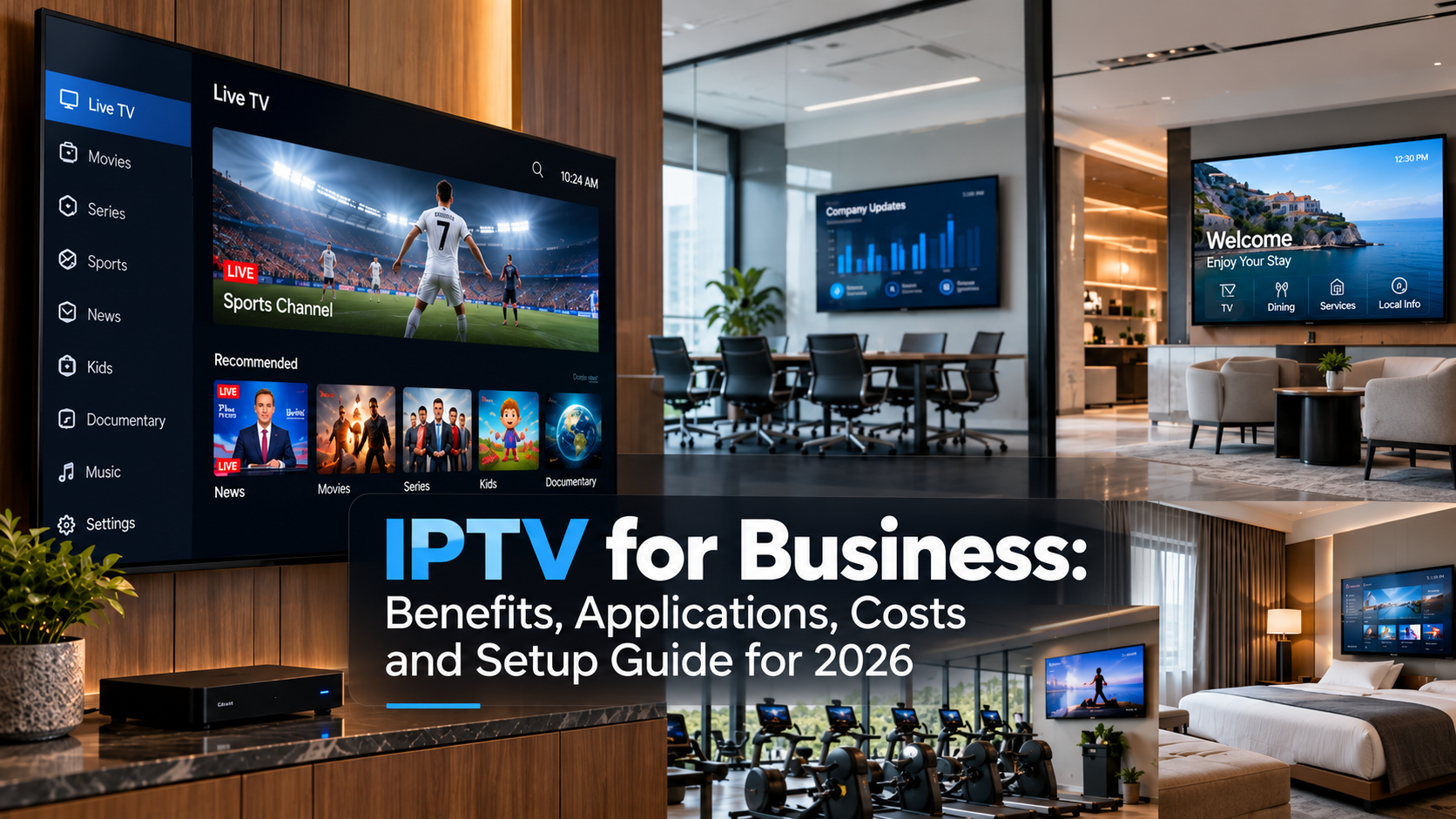
IPTV for business delivers live TV, recorded video and digital signage over your company network instead of cable or satellite. Companies use it for staff broadcasts, training, lobby screens, guest room entertainment and in-store promotions. One system handles it all, controlled from a single dashboard.
The wider IPTV market is still expanding quickly. Fortune Business Insights estimates the global IPTV market at $109.34 billion in 2026 and projects it to reach $330.19 billion by 2034, a CAGR of 14.8%.
Its report also includes corporate and enterprise, healthcare, hospitality and retail among key IPTV end uses.
This guide explains what IPTV for business is, how it works, where companies use it, its main benefits, common costs and what to consider before setting up a commercial IPTV system.
| Key Takeaways * IPTV for business lets companies deliver live TV, on-demand video, training content and digital signage over an IP network. * It is especially useful for hotels, offices, retail stores, hospitals, universities and other organizations with multiple screens or locations. * The main benefits are centralized content management, easier scaling, flexible video delivery and better internal communication. * Business IPTV can support both employee needs, such as training and company updates, and customer-facing uses, such as guest entertainment and digital signage. * Costs depend on the number of screens, network capacity, hardware, software, support and commercial content licensing. * A reliable setup starts with a clear use case, a suitable network and the right content rights before choosing the IPTV platform. |
What Is IPTV for Business?
IPTV stands for Internet Protocol Television. It sends television and video through an IP-based network.
In a business environment, IPTV can distribute live channels, recorded video, training material, company announcements and digital signage to Smart TVs, commercial displays, set-top boxes, computers and mobile devices.
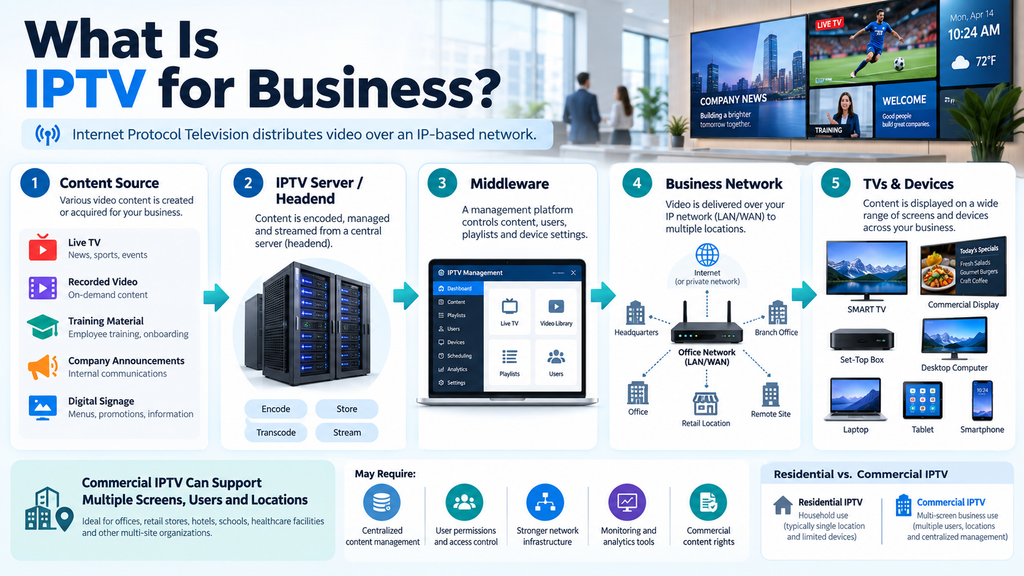
A residential IPTV setup is usually built for a household. Commercial IPTV differs in that it may need to serve multiple screens, users, or locations simultaneously.
A business system may also require centralized content management, user permissions, stronger network infrastructure, monitoring tools and commercial content rights.
In simple terms:
Content source → IPTV server or headend → Middleware → Business network → TVs and devices
That is the basic structure behind most corporate IPTV systems.
Why Businesses Use IPTV
Companies do not use IPTV only to show television.
The same infrastructure can support communication, training, customer engagement and entertainment.
A company with offices in different cities can broadcast the same executive presentation to every location. A hotel can provide live television in guest rooms while also showing hotel information and promotions.
A retailer can manage advertising screens across multiple stores from a single platform.
This flexibility is the main reason IPTV has become useful outside the home entertainment market.
Better Internal Communication
Internal communication is one of the strongest uses of IPTV for businesses.
Email is useful for detailed information, but video can be better when a company needs to deliver the same message to a large group at once.
A business can stream a company-wide meeting to different offices, meeting rooms and authorized employee devices. This is useful for organizations with remote staff or teams working across different locations.
The same system can also store important broadcasts for later viewing.
For example, a company may record a quarterly meeting and make it available as video-on-demand. Employees who missed the live session can watch it later.
This creates a central video library instead of relying only on email attachments, meeting links or separate training systems.
Employee Training and Learning
IPTV can also support employee education.
Training content can be delivered live or stored for on-demand access. A company may use the system for product training, compliance sessions, safety instructions, software tutorials, HR onboarding or sales education.
The advantage is consistency.
Every branch can receive the same training materials, and employees can access recorded sessions when their schedules allow.
For companies with many locations, this can reduce the need to organize the same in-person training session repeatedly.
Digital Signage and Customer Engagement
A business IPTV system can do more than distribute video. It can also work with digital signage.
This is especially useful in customer-facing environments.
A hotel lobby may show local information, promotions and live television. A retail store may display product videos and campaign messages. A hospital waiting area may show health information and entertainment.
The content can be updated via a single management platform.
That means a business does not need to visit every screen to change a message.
If a promotion changes, the new content can be published across many locations at once.
This is one of the key ideas in the ranking competitor as well. It highlights hospitality, retail displays, promotions, customer experience and digital signage as important IPTV applications.
IPTV for Hotels and Hospitality
Hotels are a natural fit for IPTV.
A hospitality IPTV system can provide live television, movies, hotel information and promotional content through guest room TVs.
The same screen can be used for more than entertainment.
A hotel may display restaurant opening times, spa services, checkout information, local attractions or a welcome message.
Larger properties may also connect IPTV with hotel management systems so that content can be personalized by room or guest type.
For hospitality businesses, IPTV can become both an entertainment service and a communication tool.
IPTV for Offices and Corporate Buildings
Corporate offices may use IPTV for internal television, company news, financial channels, training and live events.
A large organization can create different content for different areas.
Reception screens may show visitor information. Employee areas may display internal news. Executive offices may receive business television. Training rooms may access recorded learning content.
This is where corporate IPTV becomes more useful than simply placing a television in every room.
The company gains control over what appears on each screen.
IPTV for Retail Stores
Retail businesses use IPTV to combine video and marketing.
A store may show product demonstrations, advertising, promotional campaigns and branded video.
A large retailer can manage all of these screens centrally.
For example, a new product campaign could be launched across multiple branches simultaneously.
This helps maintain consistent branding and reduces the work required to update each location separately.
The commercial use of digital displays is especially strong in retail. Grand View Research reports that retail represented more than 19% of the global digital signage market in 2025.
IPTV for Restaurants and Bars
Restaurants, cafes and bars often use television as part of the customer experience.
A commercial IPTV setup may be used for live sports, news, entertainment, menu displays and advertising.
A venue might show a live match on one screen while another screen displays food offers or event information.
However, commercial viewing rights matter.
A home television or streaming subscription does not always grant a business permission to publicly show the same content. Businesses should confirm that their provider and content agreements cover commercial use.
IPTV for Hospitals and Healthcare
Hospitals and healthcare facilities can use IPTV for both patients and staff.
Patient rooms may receive entertainment and hospital information. Waiting areas may show educational videos or general television. Staff areas can use the same platform for training and internal announcements.
Different screen groups can receive different content.
This makes IPTV useful in environments where a single building serves several audiences with different needs.
IPTV for Schools and Universities
Educational institutions can use IPTV for campus communication and learning.
A university may distribute lectures, campus events, educational channels, training videos and emergency announcements through its network.
Recorded content can also be stored for students or staff to watch later.
For large campuses, centralized management is especially useful because video can be controlled from one system rather than managed separately in each building.
IPTV for Corporate Events
Businesses can also use IPTV for conferences, webinars, product launches and company meetings.
A live event can be streamed to offices or remote participants.
After the event, the recording can be stored for on-demand viewing.
This is useful when employees work in different time zones or when a company wants to reuse event content for training or internal communication.
The competitor article follows a similar pattern by connecting IPTV with live events, recorded sessions and corporate presentations.
Key Benefits of IPTV for Business
IPTV delivers live TV and on-demand video over IP networks rather than cable or satellite. For businesses, commercial IPTV makes it easier to manage content centrally, scale across locations, and support internal communication, digital signage, and guest entertainment.
- Corporate Communication: Share live executive updates, company news, policy changes, and emergency alerts across offices and employee screens.
- Training and Development: Deliver onboarding, compliance, product training, and instructional videos live or on demand.
- Marketing and Digital Signage: Show promotions, branded videos, product launches, menus, and advertising on lobby, retail, or waiting-area screens.
- Hospitality and Guest Experience: Give hotels and venues access to live TV, welcome screens, local information, service menus, and personalized guest content.
- Cost Efficiency and Scalability: Use existing IP networks to expand video distribution across more screens or locations without rebuilding traditional TV infrastructure.
- Centralized Management: Control channels, schedules, screen groups, user permissions, and content from one management platform.
- Multi-Location Content Delivery: Send the same or different video content to branches, offices, hotels, stores, or campuses from a central system.
- Analytics and Monitoring: Track device status, viewing activity, playback issues, and content performance to improve reliability and content planning.
Business IPTV vs Residential IPTV
The technology may look similar, but the requirements are different.
| Area | Residential IPTV | IPTV for Business |
| Main use | Home entertainment | Communication, entertainment, training, signage |
| Users | Household members | Staff, guests, customers |
| Screens | Usually a few | May be dozens or hundreds |
| Management | Individual | Centralized |
| Network | Home internet | Business LAN, WAN or enterprise network |
| Content control | Basic | Often role or location based |
| Licensing | Residential | Commercial rights may be needed |
| Support | Consumer level | Business or enterprise support |
The main difference is scale and control.
A business IPTV system needs to work reliably across many devices and may also need stronger security, content rights and network management.
What Equipment Does Business IPTV Need?
A business IPTV setup typically consists of several components.
The IPTV headend receives television or video sources and prepares them for distribution.
Encoders may convert video into formats suitable for network delivery.
Middleware manages channels, users, devices, permissions, EPG data and other service functions.
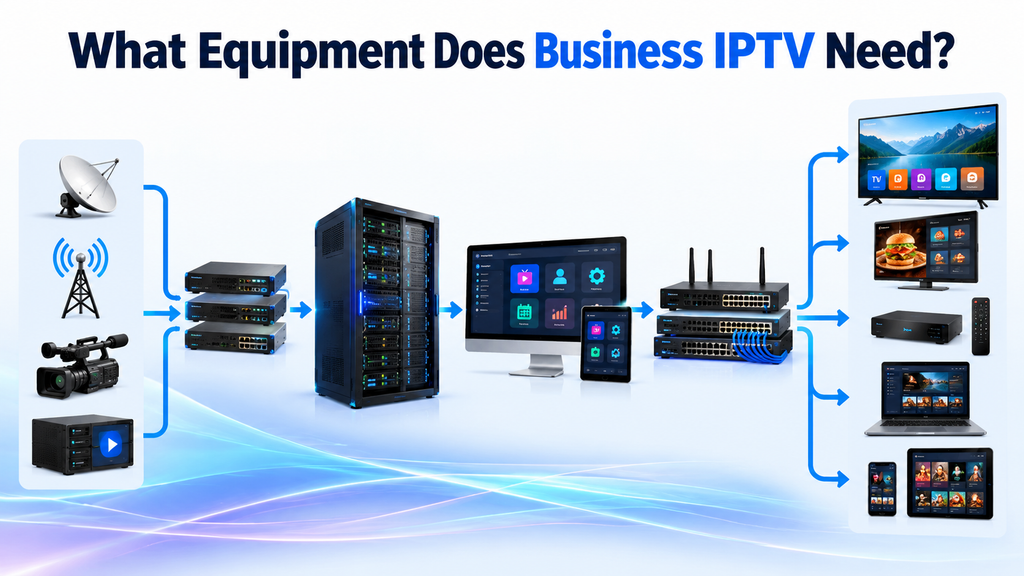
A content management system may also control digital signage, recorded video and schedules.
The network carries the streams to TVs and other endpoints.
Larger installations may use managed switches, VLANs, multicast, Quality of Service and dedicated bandwidth to improve reliability.
The endpoint may be a Smart TV, a commercial display, a set-top box, a computer, or a mobile device.
Not every business needs every component. A small office may have a simple setup, while a large hotel or hospital may need a much more advanced system.
How Much Does IPTV for Business Cost?
Business IPTV typically costs $5 to $25 per screen per month for the platform, plus content licensing, hardware and installation. A 10-screen office starts at around $2,000 upfront and $150 monthly. A 200-room hotel usually runs $30,000 to $100,000 to install.
There is no single price, because cost scales with screen count, locations, content rights, network condition and support level. Here is what makes up the total.
| Cost area | Typical range | When it applies |
| IPTV platform or software | $5 to $25 per screen monthly | Always |
| Content licensing | $10 to $60 per screen monthly | Only if you show third-party channels |
| Set-top boxes or players | $50 to $200 each | Older screens without a built-in player |
| Commercial displays | $400 to $3,000 each | New installs, or replacing consumer TVs |
| Servers and middleware | $2,000 to $20,000 | On-site deployments, not cloud |
| Network upgrades | $500 to $10,000 | Where switching or cabling cannot carry video |
| Installation | $1,000 to $15,000 | Scales with site size |
| Ongoing support | 10% to 20% of install cost yearly | Optional, standard for hotels and healthcare |
Two examples:
A small office with existing WiFi, compatible TVs and internal content only may need little more than the platform license and a few players. Expect roughly $2,000 to start.
A hotel, hospital or campus needs commercial displays, set-top boxes, middleware, servers, network upgrades, monitoring and a support contract. Costs run into tens of thousands.
One thing to watch. Do not compare providers on monthly software price alone. Content rights are often the larger line item, and they are quoted separately. A platform at $8 per screen with $50 of channel licensing costs more than one at $20 with $15 of licensing.
Ask every IPTV provider for a total cost over three years, covering both technology and content rights.
How to Set Up IPTV for a Business
The first step is to define the system’s purpose.
A company should decide whether it needs live television, employee communication, digital signage, guest entertainment, training, VOD, or a combination of these.
Next, count the screens and locations.
A system for ten office screens is very different from one serving hundreds of hotel rooms.
The network should then be checked for bandwidth, switching capacity and reliability.
After that, the business can choose between a cloud-based, on-premises, on premises or hybrid IPTV platform.
Before the full rollout, test the system on a small number of screens.
A pilot helps reveal buffering, device compatibility, EPG, network and content management problems before they affect the whole business.
Legal and Licensing Requirements
Commercial use is one of the most important areas to check before deployment.
A business should not assume that a household TV package can be used in a hotel, restaurant, office or other public environment.
Depending on the country and content, commercial IPTV may involve rights for television channels, movies, sports, music or public performance.
Licensing rules vary by region and use case.
A hotel guest room, restaurant television and internal employee training system may all have different requirements.
Businesses should confirm that their provider is authorized to supply the content and that the agreement covers the intended commercial use.
The competitor article also correctly highlights legal providers, broadcasting rules, data privacy and regulatory compliance as important business considerations. Pasted markdown
How to Choose an IPTV Solution for Business
Start with your actual use case.
A hotel may care most about guest room entertainment and property information. An office may need internal communication and training. A retailer may care more about digital signage and promotional video.
The next consideration is scale.
Check how many screens you need now and how many you may need later.
Then check device compatibility, network requirements, centralized management, support and commercial content rights.
For large deployments, support quality can be as important as features.
A system with many advanced tools is not useful if it becomes difficult to manage or unreliable during business hours.
The Future of IPTV for Business
Business IPTV is becoming more connected with digital signage, cloud platforms and enterprise communication systems.
Cloud-based management can make it easier to control screens across different locations.
AI may also play a role in content recommendations, scheduling, analytics and personalization.
Hotels and retail businesses may use more personalized screen content based on location or audience.
Interactive video may also become more common in training, events and customer experiences.
The competitor article follows a similar direction, focusing on integration, interactivity, accessibility, and greater scalability as future IPTV trends. Pasted markdown
Is IPTV Worth It for a Business?
For many organizations, yes.
IPTV is most useful when a business needs to manage video across several screens, departments, or locations.
It can combine television, internal communication, training, VOD, and digital signage into a single system.
However, it is not necessary for every company.
A small business with only one or two televisions may find a standard commercial TV service easier to manage.
The value of IPTV increases when centralized management, multiple locations, flexible content and business communication become important.
Conclusion — IPTV Solutions for Business
IPTV for business is not simply a replacement for cable TV. It is a video distribution system that can support communication, training, entertainment and digital signage across an organization.
Hotels can use it for guest entertainment. Offices can use it for company broadcasts. Retail stores can use it for promotions. Hospitals and universities can use it for information and training.
The main benefits are centralized management, flexible content and easier expansion across many screens or locations.
Before choosing a system, define what the business actually needs, check the network, confirm commercial content rights and make sure the platform can scale with future demand.
For organizations that need to manage video across more than a few screens, a well-planned business IPTV solution can be more useful than a simple television service.
FAQs on Business IPTV
What is IPTV for business?
A TV and video system that runs over your company network. It delivers live channels, recorded video and digital signage to screens across one or many sites, managed from one dashboard.
Is IPTV legal for business use?
Yes, if your provider holds commercial distribution rights for the content. A residential subscription does not cover public viewing in a venue. Confirm commercial rights in writing before signing.
How much does business IPTV cost?
Software typically runs $5 to $25 per screen monthly, plus content and hardware. A 10-screen office starts around $2,000 up front and $150 a month. Hotels and hospitals cost considerably more.
What is the difference between IPTV and OTT for business?
IPTV runs over a network you control, which gives steadier quality. OTT runs over the open internet. Many business systems now use both.
How can I start my own IPTV business?
You can start an IPTV business by choosing a target market, securing legal content rights, selecting an IPTV platform, setting up billing and support, and launching with a clear pricing and marketing plan.
Do I need a TV license for IPTV?
It depends on your country and how you use IPTV. For commercial use, you may need content distribution rights, broadcasting permissions, or public performance licenses. A residential TV license alone may not cover business use.
How to get an IPTV dealership?
To get an IPTV dealership, find a legitimate IPTV provider with an authorized reseller program, verify its content licensing, compare wholesale pricing and support, then sign a reseller agreement before selling the service.
Is reselling IPTV legal?
Yes, reselling IPTV can be legal if the provider has the required content rights and gives you permission to resell the service. Reselling unauthorized or pirated streams is illegal in many countries.
How to get into the IPTV business?
To enter the IPTV business, choose a legal business model, define your target audience, secure content rights, select an IPTV platform, set pricing, and develop a customer support and marketing plan.
What is the best IPTV supplier?
The best IPTV supplier is a licensed provider that offers reliable streams, clear reseller terms, strong uptime, EPG support, device compatibility, and responsive technical support. Always verify its content rights before partnering or reselling.
Where can I find wholesale IPTV products?
You can find wholesale IPTV products through licensed IPTV distributors, authorized resellers, white label IPTV platforms, and commercial content aggregators. Before buying, verify content rights, reseller terms, pricing, support, and whether the supplier allows legal redistribution.
How do I get an IPTV provider?
To get an IPTV provider, compare licensed providers that offer the channels, device support, pricing, EPG, uptime, and support you need. Verify the provider’s content rights and terms before subscribing or reselling.
How do people sell IPTV?
People sell IPTV by operating a licensed service or joining an authorized reseller program. They typically buy access at wholesale rates, create customer plans, handle billing and support, and resell the service under agreed terms.
How to find a provider for IPTV?
To find an IPTV provider, compare licensed providers and authorized distributors based on channel availability, stream quality, device support, EPG, pricing, uptime, and customer support. Always verify content rights and reseller terms before signing up.