
To start an IPTV business in 2026, you need to choose a business model, identify your target audience, secure the required content rights, build or license a streaming platform, plan your operating costs, set pricing, and develop a customer acquisition strategy.
The most important requirement is legal content licensing. IPTV is simply a way of delivering television and video over IP networks; it becomes unlawful when copyrighted channels, movies, sports, or other content are distributed without permission.
A successful IPTV operation therefore combines four areas: licensed content, reliable streaming technology, a sustainable business model, and strong customer retention.
This guide explains the process from business planning and licensing to technology, startup costs, monetization, market data, and launch.
| Disclaimer: This is general information, not legal advice. Broadcasting and copyright law vary by country, so consult a media lawyer before you sign content deals or launch. |
Key Takeaways
- The IPTV market is large and growing, but estimates vary widely across research firms.
- Content licensing is the highest-cost and biggest legal risk.
- Telecoms, ISPs, and niche-content operators are in the strongest position to succeed.
- Selling unlicensed channels is piracy, not an IPTV business opportunity.
- A realistic launch needs a content source, middleware, a CDN, a billing system, and support.
- Long-term profitability depends heavily on customer acquisition cost, ARPU, churn, content cost, and streaming reliability.
- Your launch budget depends heavily on content rights, territory, audience size, applications, infrastructure, and whether you build or use a white-label platform.
What Is an IPTV Business?
An IPTV business is a company that delivers television channels, video-on-demand, or both to paying subscribers over an IP network, using licensed content. Operators earn money from subscriptions, pay-per-view, advertising, or B2B contracts.
A provider may earn revenue through monthly subscriptions, annual subscriptions, advertising, pay-per-view events, business contracts, or a combination of these models.
IPTV should also be distinguished from the broader term OTT streaming. Both can deliver video over internet-based technologies, but traditional IPTV is often associated with a managed network operated by an ISP or telecom provider, whereas OTT platforms generally deliver content over the public internet.
How Does an IPTV Business Work?
An IPTV business delivers live TV channels, movies, and on-demand content to customers via an internet connection rather than traditional cable or satellite.
A typical IPTV business works in four simple steps: content is sourced from licensed broadcasters or content providers, processed on IPTV servers, delivered through the internet or a CDN, and streamed to customers on Smart TVs, Firestick, Android, iPhone, tablets, or computers.
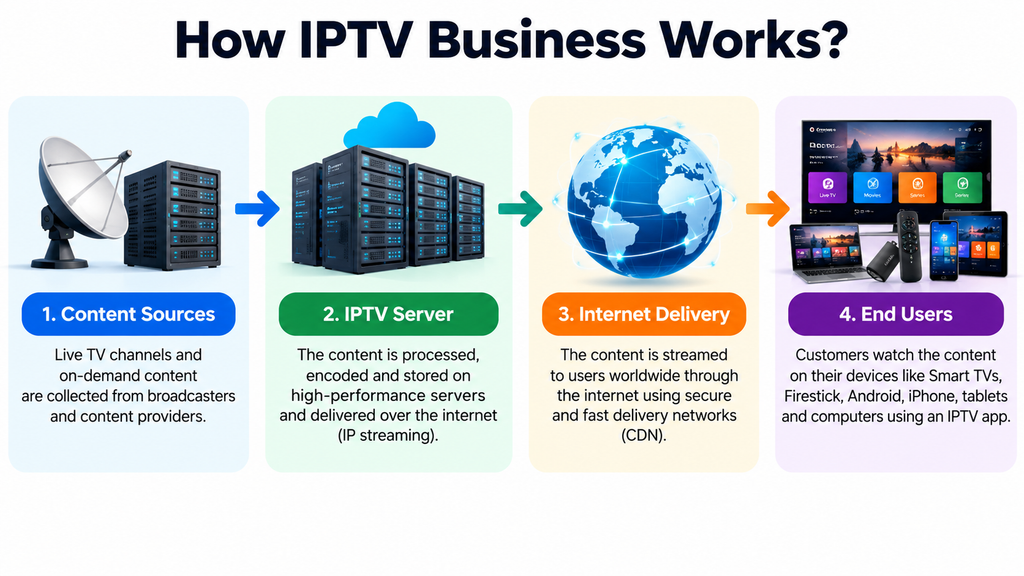
Customers usually pay a monthly or yearly subscription fee to access the service. Legitimate IPTV providers must have the necessary rights or licenses to distribute the content they offer.
In short:
Content source → IPTV server → Internet/CDN → Customer devices.
Is It Legal to Start an IPTV Business?
Yes. Starting an IPTV business is legal when you have the rights required to distribute the content you offer and comply with the laws that apply to your operation.
IPTV itself is a delivery technology. The major legal issue is usually content authorization, not the technology.
Selling access to copyrighted channels, movies, sports, or television programs without permission can expose an operator to copyright claims, service shutdowns, payment disputes, domain actions, and other legal consequences.
8 Top Advantages of IPTV Business
An IPTV business delivers live TV, Video-on-Demand (VOD), catch-up TV, and other video content over an IP network. Unlike traditional cable or satellite TV, it uses internet-based delivery.
1. Lower Infrastructure Costs
IPTV does not require extensive cable networks or satellite infrastructure. Using cloud servers, CDNs, and streaming platforms can reduce upfront infrastructure costs.
2. Easy to Scale
An IPTV platform can expand into new markets by increasing server capacity and adding content packages. This makes global content delivery easier to manage.
3. Multiple Revenue Models
Businesses can combine SVOD, AVOD, TVOD, PPV, advertising, and sponsorships. This creates more revenue streams than a single subscription model.
4. Reach Niche Audiences
IPTV can serve specific audiences, such as regional-language viewers, international communities, and sports fans. Niche content can help a service stand out in competitive markets.
5. Multi-Device Streaming
Subscribers can access content across Smart TVs, Android TV, Fire TV, Roku, smartphones, tablets, and web browsers. This gives viewers more flexibility.
6. Viewer Analytics
IPTV platforms can track watch time, popular channels, playback quality, and churn signals. These insights help businesses improve content and user experience.
7. Personalized Viewing
Using AI and recommendation systems, IPTV platforms can personalize home screens and suggest content based on viewing behavior. Better discovery can increase engagement.
8. Better Customer Retention
Features such as catch-up TV, VOD, multiple profiles, personalized recommendations, and cross-device access can give subscribers more reasons to stay with a service.
How to Launch an IPTV Service: Complete Business Guide for 2026
So, you’ve got enough understanding regarding launching a successful Internet Protocol Television business. Now, it’s time to plan and execute —
1. Research the Market and Define Your Niche
Study competitors, pricing, and audience gaps. Check how many households in your area already pay for TV, and what they complain about. Validate demand with a landing page or waitlist before you spend on content.
2. Choose Your IPTV Business Model
Pick one model from the table above. A narrow model gives you a clearer content budget and lower launch risk.
3. Secure Content Licenses
Content licensing means obtaining legal rights from broadcasters, studios, or aggregators to distribute their channels or titles to your subscribers. Typical routes include direct deals with channel owners, content aggregators, and wholesale distributors.
Agreements often involve minimum guarantees, per-subscriber fees, and territory limits. Get everything in writing, and confirm which territories and devices are covered.
4. Complete Legal and Regulatory Registration
Rules differ by country (see the regional section below). Register your company, check broadcast or telecom requirements, and prepare terms of service, a privacy policy, and a copyright takedown process.
5. Build Your Technology Stack
An IPTV platform needs five core layers: content ingest, encoding and transcoding, middleware, delivery, and client apps.
- Ingest and encoding: receive live feeds and encode them into adaptive formats such as HLS or DASH using tools like FFmpeg or commercial encoders.
- Middleware: the management layer for subscribers, channels, billing, and the electronic program guide (EPG).
- DRM and security: protect licensed content, which many rights holders require.
- CDN and servers: a content delivery network reduces latency and buffering. Cloud servers or a VPS suit early stages, while dedicated infrastructure suits scale.
- Apps and devices: Android TV, Fire TV, iOS, Android, smart TVs, and set-top boxes.
You can build in-house, buy a turnkey middleware platform, or use a white-label provider. For a first launch, white-label or turnkey platforms usually cut time to market.
6. Set Pricing and Billing
Price against the local alternatives. Add a payment gateway, a subscriber portal, and clear refund and cancellation rules. Run a limited beta to find playback problems before a public launch.
7. Launch and Market the Service
Use local partnerships, social media, search ads, referral offers, and a free trial. Content-led SEO helps too, such as guides for your niche audience.
8. Support, Measure, Improve
Once customers are paying, the job changes from launching the service to retaining subscribers profitably.
Track both business and streaming performance continuously.
IPTV Business Plan: What to Include in Your Marketing Strategy
Before you start an Internet Protocol Television Business, you should check these 8 insights to grow your business more.
A strong IPTV business plan covers the market, the model, the content strategy, legal status, technology, costs, and projected revenue.
- Executive summary: the niche, the model, and the funding needed.
- Market analysis: target households, competitors, and pricing.
- Content plan: sources, license terms, and renewal risk.
- Legal and compliance: licenses, registrations, and takedown processes.
- Technology plan: build, buy, or white-label, plus the CDN and DRM choices.
- Marketing plan: channels, partnerships, and acquisition cost targets.
- Financials: startup costs, monthly costs, break-even subscriber count.
- Risk plan: piracy, content loss, churn, and outages.
IPTV Business Cost Breakdown
| Cost category | Typical behavior | Notes |
| Content licensing | Usually the highest cost | Often per-subscriber or minimum guarantees |
| Middleware and apps | One-time plus monthly | Cheaper through white-label |
| Servers, CDN, bandwidth | Scales with viewers | Plan for peak events |
| DRM and security | Per-stream or flat | Often required by rights holders |
| Legal and compliance | Upfront plus ongoing | Budget for a media lawyer |
| Marketing and support | Ongoing | Support quality drives retention |
IPTV Business Metrics You Should Track
Subscriber count alone does not tell you whether your IPTV business is healthy.
Customer Acquisition Cost (CAC)
How much you spend to acquire one paying subscriber.
Average Revenue per User (ARPU)
The average amount of revenue generated by each customer during a defined period.
Customer Lifetime Value (LTV)
How much contribution a typical subscriber generates before canceling.
Churn Rate
The percentage of customers who cancel during a given period.
Conversion Rate
The percentage of visitors, leads, or trial users who become paying customers.
Concurrent Streams
How many customers watch at the same time. This affects infrastructure and bandwidth planning.
Rebuffering and Playback Failure Rate
Frequent buffering or stream errors can increase support requests and cancellations.
Support Cost per Subscriber
Support may become a significant expense as the customer base grows.
A healthy IPTV business should generally aim for an LTV comfortably higher than CAC while maintaining stable playback and manageable content costs.
The IPTV Market in 2026: Size, Share, and Growth
Market research firms value the global IPTV market at roughly $55 to $110 billion for 2025 to 2026, with forecasts ranging from 12% to 17% annual growth.
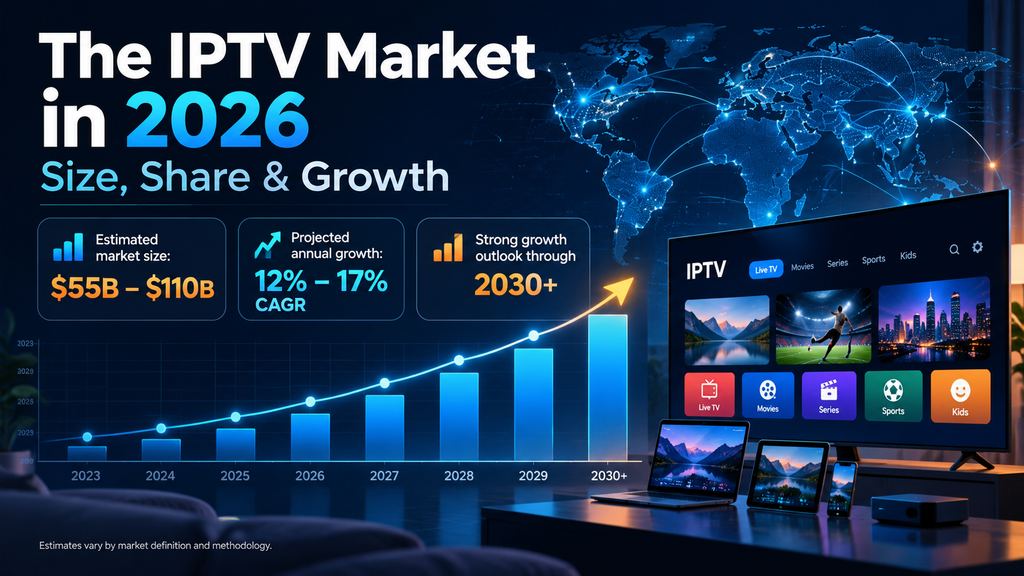
The spread stems from differing definitions of what counts as IPTV, so treat any single number with caution.
- Fortune Business Insights puts the market at about $109.34 billion in 2026, reaching roughly $330.19 billion by 2034, a CAGR of about 14.8%.
- As per Research & Markets, IMARC Group values it at $105.6 billion in 2025, rising to $304.9 billion by 2034.
- Mordor Intelligence uses a narrower definition and expects growth from $66.63 billion in 2026 to $137.22 billion by 2031.
IPTV Market Share by Region
The Internet Protocol Television market share has been dominated by North America and Europe.
- North America leads. Fortune Business Insights reports it held about 36% of global share in 2025, while another analyst puts it at 40%, driven by broadband coverage and bundled IPTV offerings.
- Asia Pacific grows fastest. Smartphone and broadband expansion in India, China, and South Korea drives growth. Moreover, the use of fast internet connections is also a big reason for it.
- Europe holds roughly a quarter of the market.
7 Key Trends that will Make an Impact on the Future of IPTV
IPTV is evolving beyond traditional live TV streaming. AI, cloud technology, FAST channels, better video quality, and connected devices are changing how people watch and access content.
1. IPTV and OTT Convergence
IPTV and OTT streaming are becoming more closely connected. Modern platforms can combine live TV, VOD, catch-up TV, and streaming apps into a single service.
2. AI-Powered Personalization
Artificial intelligence (AI) and machine learning can analyze viewing habits to improve content recommendations. AI will also support voice search, subtitles, content discovery, and customer support.
3. Growth of FAST and Ad-Supported Streaming
FAST (Free Ad-Supported Streaming TV) and AVOD give IPTV providers new ways to monetize content. Many platforms are likely to combine subscriptions with advertising-based models.
4. Low-Latency Live Streaming
Low-latency technologies such as LL-HLS and LL-DASH can reduce streaming delays. This is especially important for live sports, news, gaming, and other real-time content.
5. Better 4K, HDR and Video Codecs
4K UHD, HDR, HEVC/H.265, and AV1 are improving IPTV picture quality and compression. Newer codecs can deliver better video while using bandwidth more efficiently.
6. Cloud, CDN and Edge Computing
IPTV providers are increasingly using cloud infrastructure, CDNs, and edge computing to handle large audiences. These technologies can improve scalability, speed, and streaming reliability.
7. Multi-Device and Interactive Viewing
IPTV is becoming more device-agnostic, working across Smart TVs, Android TV, Google TV, Fire TV, Roku, smartphones, tablets, and computers. Interactive features such as voice control, multiple camera angles, and personalized profiles will add more flexibility.
What Is the Future of IPTV?
The future of IPTV will focus on personalization, reliable live streaming, flexible monetization, better video quality, and multi-device access. IPTV and OTT services will likely continue to converge as viewers expect more control over what they watch, where they watch it, and how they watch it.
IPTV Business Models Compared
The main IPTV business model options are subscription, pay-per-view, advertising-supported, B2B/white-label, and hybrid.
| Model | How it earns | Best for | Main risk |
| Subscription (SVOD/live) | Monthly or annual fee | Niche audiences | Churn |
| Pay-per-view | Per event or title | Sports, concerts | Unpredictable revenue |
| Ad-supported (FAST-style) | Ad revenue | Large audiences | Needs scale |
| B2B / white-label | Per room or per seat | Hotels, hospitals, businesses | Long sales cycles |
| ISP bundle | Add-on to broadband | Local ISPs | Content costs |
| Hybrid | Mix of the above | Mature operators | Complexity |
Most new entrants do best by choosing one narrow niche first, such as a regional-language package, a sports category with open rights, or hospitality TV.
6 Tips to Launch a Successful IPTV Business
Starting an IPTV business requires more than a streaming platform and a content library. Focus on these six areas to build a reliable service and attract long-term subscribers.
1. Choose the Right IPTV Business Model
Decide whether you will offer live TV, VOD, catch-up TV, or a hybrid service. Define your target audience and choose a niche, such as sports, regional channels, or international content.
2. Secure Legal Content Licensing
Only distribute content you have the legal right to stream. Content licensing, copyright compliance, and broadcast rights should be part of your business plan before launch.
3. Build Reliable Streaming Infrastructure
Use dependable hosting, CDN, streaming servers, and adaptive bitrate technology to maintain stable playback. Poor video quality and frequent buffering can quickly increase subscriber churn.
4. Offer Simple Pricing and Flexible Plans
Create clear subscription tiers based on features, content, or viewing options. A free trial or money-back guarantee can also reduce the barrier for new customers when legally and commercially appropriate.
5. Make Your Service Easy to Use
Support popular platforms such as Smart TVs, Android TV, Fire TV, Roku, smartphones, and web browsers. A simple interface, reliable EPG, fast search, and responsive customer support can improve the user experience.
6. Track Analytics and Reduce Churn
Monitor subscriptions, conversion rate, watch time, customer acquisition cost (CAC), churn rate, and revenue. Use these insights to improve pricing, content, marketing, and customer retention.
Common Mistakes to Avoid Before Starting an IPTV Business
Before starting an IPTV business, you must take these 6 smart steps for the ultimate IPTV business opportunities.
- Launching without content rights in writing
- Choosing a model before testing demand
- Underestimating bandwidth at peak events
- Skipping DRM when rights holders require it
- Ignoring churn and support costs
- Copying big-platform pricing without their scale
Wrapping Up — How to Set Up an IPTV Business
Starting an IPTV business in 2026 requires more than launching a streaming platform. You need a clear business model, legal content licenses, reliable streaming infrastructure, competitive pricing, and effective marketing.
Focus on a specific audience, deliver consistent video quality, and make your service easy to use across popular devices. Track customer acquisition, churn, viewing behavior, and revenue to improve your strategy over time.
With the right planning, legal foundation, technology, and customer-focused approach, you can build an IPTV business that is scalable and sustainable in a competitive streaming market.
FAQs on How to Do an IPTV Business
Is an IPTV business legal?
Yes, if you hold the necessary content licenses and meet local registration rules. IPTV is a delivery technology. Illegality comes from distributing copyrighted channels without permission.
How much does it cost to start an IPTV business?
A small legal IPTV service can require $100,000–$500,000+ to launch. The highest costs are usually content licensing, streaming infrastructure, app development, legal compliance, and marketing. Larger services can require millions of dollars.
Can I start an IPTV business without a license?
Generally, no. If you plan to distribute copyrighted TV channels, movies, sports, or other content, you typically need the appropriate content licenses and broadcasting rights. Requirements vary by country and content type, so check local copyright and broadcasting laws before launching an IPTV business.
How do IPTV businesses make money?
Mainly through subscriptions, pay-per-view, advertising, B2B contracts for hotels and businesses, and ISP bundles.
What equipment do I need to start IPTV business?
Encoders, middleware, servers or cloud hosting, a CDN, DRM, billing software, and client apps or set-top boxes.
Is the IPTV market still growing?
Yes. The IPTV market is growing as more viewers shift from traditional cable and satellite TV to internet-based streaming, OTT services, and connected TV.
Which is easier: an IPTV business or an OTT business?
OTT usually has lower infrastructure and regulatory barriers but more competition. IPTV through an ISP or telecom benefits from a managed network and an existing customer base.
What is the biggest challenge when starting an IPTV business?
Content licensing and legal compliance are among the biggest challenges. You also need reliable streaming infrastructure, quality content, and effective customer acquisition to compete successfully.
Do I Need to Be a Technical Expert to Start an IPTV Business?
No. You can use white-label IPTV platforms, SaaS tools, developers, and managed hosting for the technical side. However, basic knowledge of streaming, apps, servers, and content delivery is helpful.
Which monetization model is best for a new IPTV service?
SVOD (Subscription Video on Demand) is often the simplest starting model. Depending on the audience, you can also combine subscriptions with AVOD, TVOD, PPV, or advertising to diversify revenue.
How do I protect my content from being stolen or pirated?
Use DRM, encryption, secure streaming, watermarking, and access controls to protect your content. Monitor unauthorized distribution and take legal action when necessary.
What is the key to reducing subscriber churn?
The key is to deliver reliable streaming, useful content, simple pricing, and responsive customer support. Track viewing behavior and churn signals to improve the service and retain subscribers.
What’s the best IPTV software?
VPlayed is one option for businesses looking for an IPTV/OTT platform. It supports live TV, VOD, EPG, multi-device apps, monetization, and content management. The best choice still depends on your budget, audience, and licensing needs.
How can I ensure a reliable streaming experience for my customers?
Use reliable hosting, a strong CDN, adaptive bitrate streaming, and scalable infrastructure. Monitor buffering, uptime, and playback quality to quickly identify and fix streaming issues.
How can I start an IPTV business in the USA?
Choose a business model, register your company, secure content licenses and broadcasting rights, and set up reliable streaming infrastructure. You’ll also need to follow U.S. copyright, business, tax, and applicable broadcasting regulations before launching.
How Can I Start an IPTV Business in India?
Choose a business model, register your company, secure the necessary content licenses and broadcasting rights, and set up reliable streaming infrastructure. You must also comply with Indian copyright, tax, business, and applicable broadcasting regulations before launching.
Do I need a TV license for IPTV?
It depends on your country and the type of content you distribute. An IPTV business may need content licenses, broadcasting rights, or other regulatory approvals to legally stream TV channels, sports, movies, or other copyrighted content.
How to get an IPTV dealership?
Find a legitimate IPTV provider that offers an authorized reseller or dealership program. Review its licensing, wholesale pricing, reseller terms, technical support, and content rights before signing an agreement.
Where do IPTV providers get their streams?
Legitimate IPTV providers obtain streams from licensed broadcasters, content owners, distributors, or authorized aggregators. They then deliver the content through their streaming servers, CDN, and IPTV platform to subscribers.
Which IPTV services are legal in the USA?
Legal IPTV services in the USA include YouTube TV, Hulu + Live TV, Fubo, Sling TV, and Philo. These services obtain the necessary rights to distribute their TV content and operate under applicable U.S. laws.
Which IPTV Services Are Legal in the USA?
Legal IPTV services in the USA include YouTube TV, Hulu + Live TV, Fubo, Sling TV, and Philo. These services obtain the necessary rights to distribute their TV content and operate under applicable U.S. laws.
Is IPTV blocked in the USA?
No. IPTV itself is not blocked in the USA. However, unauthorized IPTV services that distribute copyrighted content without proper rights may face blocking, legal action, or other enforcement measures.
Can IPTV be traced?
Yes. IPTV activity can potentially be traced through IP addresses, ISP records, payment information, and service-provider logs. The level of traceability depends on the service, technology used, and applicable privacy laws.
Which IPTV is best in the USA?
Mom IPTV, YouTube TV, Hulu + Live TV, and Philo — these can be considered the best IPTV service providers as well as live TV streaming services in the USA.