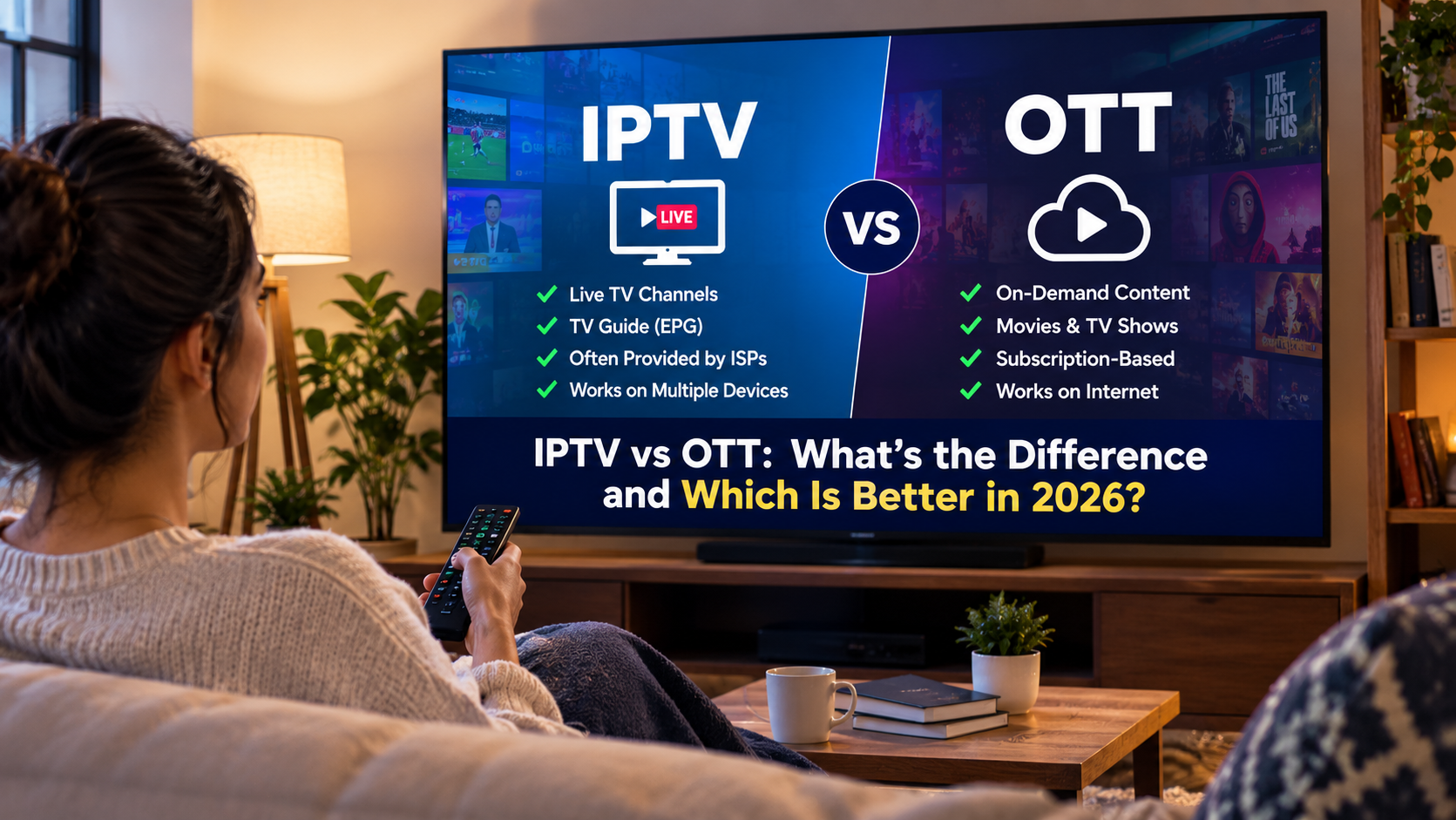
IPTV and OTT both deliver video over the internet, but they differ in how content reaches viewers. IPTV (Internet Protocol Television) often uses a service provider’s managed network, while OTT (over-the-top) streaming delivers content over the public internet through apps and websites.
IPTV can be a good fit for hotels, hospitals, campuses, and viewers who prefer a traditional TV service. OTT is often better for audiences who want to stream on different devices, launch a streaming service quickly, or reach viewers in multiple locations.
The main difference is not simply the technology. It is how the service is delivered, who controls the network, and what viewers or businesses need.
This guide compares IPTV vs OTT, explains how each works, reviews their costs and limitations, and helps you choose the right option.
IPTV vs OTT at a Glance
| Factor | IPTV | OTT |
| Network | Private, managed IP network | Public internet |
| Who runs it | Telecom, ISP, or enterprise | Streaming platform, broadcaster, business |
| Live delivery | Often multicast | Unicast via CDN |
| Quality control | High, network-level | Depends on the viewer’s connection |
| Devices | Operator-approved boxes and apps | Almost anything with a screen |
| Reach | Regional or closed network | Global |
Typical latency | 2 to 5 seconds | 6 to 30 seconds, under 5 with low-latency protocols |
| Setup time | Weeks to months | Days |
Monetisation | Bundled subscriptions | SVOD, AVOD, TVOD, FAST, hybrid |
Examples | AT&T U-verse, hotel room TV, campus systems | Netflix, YouTube, Disney+, Tubi |
What is IPTV?
IPTV (Internet Protocol Television) delivers live TV, catch-up TV, and on-demand video through a service provider’s network. Because the provider controls the network, IPTV can offer more stable streaming and better control over picture quality.
That network is usually run by a telecom company, an ISP, or a private organization such as a hotel group, hospital or university.
How IPTV Works
A typical IPTV deployment involves a headend that receives channel feeds, middleware that manages users and permissions, an electronic program guide, and either set-top boxes or operator-approved apps at the viewing end.
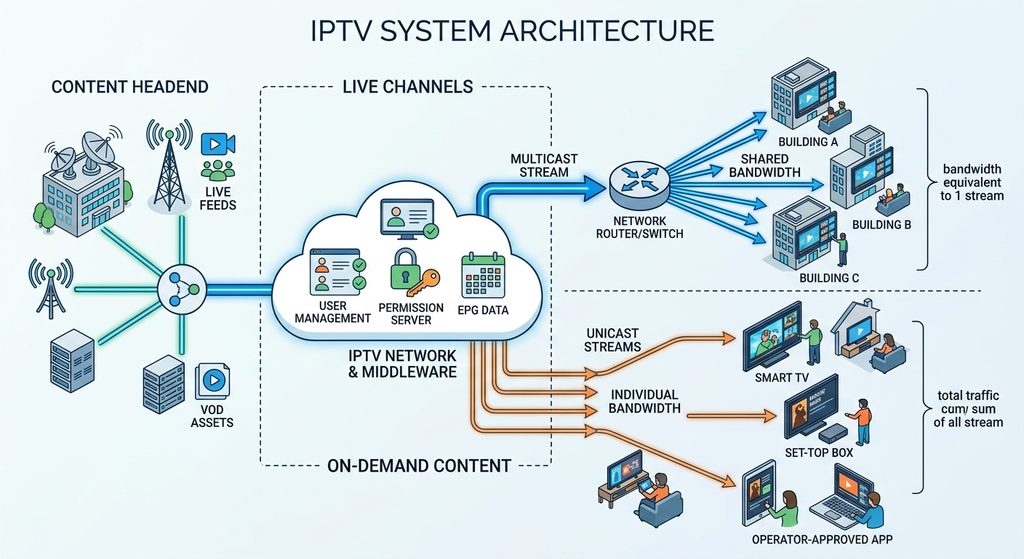
For live channels, IPTV usually uses multicast. One stream goes out and many viewers receive it. Fifty screens watching the same channel consume the bandwidth of one. On-demand content uses unicast, a separate stream per viewer.
That multicast efficiency is the core technical advantage, and it is why IPTV still dominates in buildings full of screens.
Strong Points of Internet Protocol TV
- Predictable picture quality, because the operator controls the pipe
- Low latency, typically 2 to 5 seconds, close to broadcast
- Efficient at scale within a building or network
- Network-level access control
- A familiar channel-surfing experience with a proper EPG
Where IPTV falls short
- Tied to one network, so viewers cannot take it with them
- Slow to deploy, often weeks or months
- Limited device choice, usually operator-approved hardware
- Regional restrictions
What Is OTT?
OTT (over-the-top) video is delivered over the public internet, bypassing any managed network or cable operator. Netflix, YouTube, Disney+ and Tubi are all OTT. The content travels “over the top” of whatever internet connection the viewer has.
This is what most people mean when they say streaming.
How OTT Works
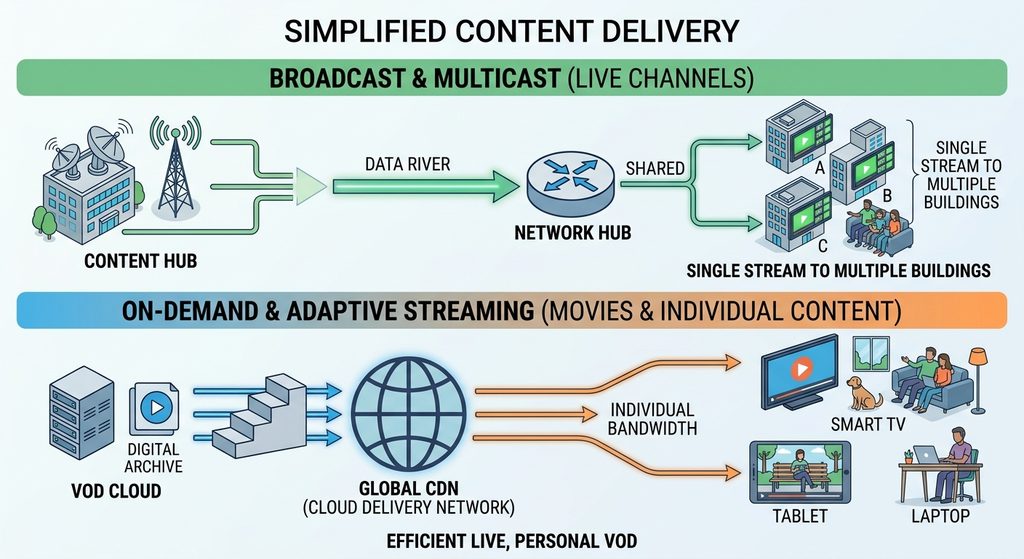
OTT relies on cloud video hosting, content delivery networks, and adaptive bitrate streaming. The two dominant playback protocols are HLS and MPEG-DASH.
Adaptive bitrate is the key idea. The player continuously measures the viewer’s connection and switches between quality levels midstream. That is why a video drops to a softer picture instead of freezing when your connection dips.
For live video where delay matters, newer stacks add LL-HLS and CMAF for playback, and SRT for getting the feed from camera to server reliably.
Strong Points of Over-the-Top Platforms
- Works on almost any device: phone, laptop, smart TV, games console, streaming stick
- Global reach from day one
- Fast to launch, often days rather than months
- Flexible monetization through subscriptions, ads, rentals or free ad-supported channels
- Full control over branding and the viewer relationship
- Detailed analytics on who watched what
Where OTT falls short
- Quality depends on the viewer’s own connection, which you cannot control
- Higher latency by default, though low-latency protocols have closed much of that gap
- Bandwidth costs scale with every viewer, because each one needs their own stream
- More exposure to piracy without proper DRM
The 7 Real Differences Between IPTV OTT
The differences come down to network ownership, delivery method, device reach, latency, quality control, cost structure and monetization. Everything else is a consequence of the first one.
1. Who Owns the Network
IPTV runs on infrastructure that the operator controls end-to-end. OTT runs on the open internet, which nobody controls.
This single fact produces every other difference on this list.
2. One Stream or Many
IPTV uses multicast for live channels, so one stream serves many viewers. OTT delivers a separate stream to each viewer via a CDN.
In a hotel with 300 rooms watching the same channel, that difference is enormous. Across 300 homes on different connections, multicast is not an option.
3. Where You Can Watch
IPTV operates over the operator’s network on approved devices. Leave the building or the region and it stops.
OTT works anywhere with internet, on nearly any device. Phone on a train, laptop in a hotel, smart TV at home, all the same account.
4. How Far Behind Live You Are
IPTV typically runs 2 to 5 seconds behind real time, close to broadcast. Standard OTT runs 6 to 30 seconds behind.
This is why neighbors with cable cheer a goal before OTT viewers see it. Low-latency protocols pull OTT under 5 seconds, but they add cost and complexity, so most services do not bother unless the content demands it.
5. Who Controls Quality
IPTV quality is managed by the operator and is consistent. OTT quality depends on the viewer’s broadband connection, their Wi-Fi, and the network’s congestion at that moment.
Adaptive bitrate smooths this out, but it does so by lowering picture quality rather than by fixing the connection.
6. How Costs Scale
IPTV has high fixed costs and low marginal costs. Building the network is expensive; adding viewers inside it is cheap.
OTT inverts that. Starting is cheap, but every additional viewer consumes bandwidth you pay for.
7. How You Make Money
IPTV revenue is usually a bundled subscription sold by a telecom. OTT supports subscriptions, advertising, rentals, free ad-supported channels, or any combination.
That flexibility is the main reason independent publishers choose OTT.
Which Should You Choose?
If you are a viewer, you are almost certainly choosing OTT, because IPTV in the strict sense is sold by telecoms as part of a broadband bundle. If you are a business, choose IPTV when your audience is within a network you control, and OTT when it is not.
If You Are a Viewer Picking a Service
You are not really choosing between IPTV and OTT. You are choosing between a telecom TV bundle and an app.
A telecom IPTV bundle makes sense if you want a single bill with your broadband, mostly watch live channels, want a set-top box and a traditional guide, and your broadband is unreliable enough that managed delivery matters.
OTT apps make sense if you watch on several devices, want to cancel and resubscribe freely, watch more on demand than live, or want to pay only for what you use.
One warning. Subscriptions advertised online as “IPTV” with thousands of channels for a low monthly price are not telecom IPTV. They run over the open internet, and many are not licensed.
If You Are a Business Choosing a Delivery Model
Start with where your audience is, not with the technology.
| Your Situation | Better fit |
| Viewers inside a hotel, hospital, campus or office you control | IPTV |
| Viewers scattered across regions and devices | OTT |
| You need guaranteed quality in a fixed environment | IPTV |
| You need to launch in weeks, not months | OTT |
| You want subscription, ad or pay-per-view revenue | OTT |
| You already own the network infrastructure | IPTV |
| You want branded apps on smart TVs | OTT |
| Your content is internal and must not leave the building | IPTV |
Choose IPTV if your viewers are in a defined physical space, you control the network, service predictability matters more than reach, and your workflow resembles managed television.
Choose OTT if your audience is distributed, you want branded apps, you need flexible monetization, or speed to market matters.
Most organizations that are not telecoms, hotels, hospitals or campuses will land on OTT. That is not because OTT is better in the abstract. It is because most audiences are not sitting inside a network you own.
IPTV vs OTT: Cost Comparison
IPTV costs more to set up and less per viewer. OTT costs almost nothing to start and more as your audience grows. The crossover point depends on how concentrated your viewers are.
| For viewers | Telecom IPTV bundle | OTT apps |
| Monthly cost | $50 to $120, usually bundled with broadband | $0 to $20 per service |
| Hardware | Set-top box, often rented | None, or a $30 to $50 streaming stick |
| Contract | Often 12 to 24 months | Usually monthly |
| Hidden costs | Box rental, extra room fees | Subscription creep across several services |
| For businesses | IPTV deployment | OTT deployment |
| Setup | $5,000 to $100,000+ depending on site size | $0 to $5,000 |
| Time to launch | Weeks to months | Days |
| Per-viewer cost | Very low once built | Bandwidth and CDN fees scale with viewers |
| Hardware | Headend, middleware, set-top boxes | None required |
| Ongoing | Maintenance and support contract | Platform fee plus bandwidth |
The structural difference is that IPTV front-loads cost and OTT spreads it. A hotel with 300 rooms pays once. A streaming service with 300,000 viewers pays every month, and pays more as it grows.
If your audience is large and concentrated in one building, IPTV is usually cheaper over time. If it is distributed, OTT is the only practical option at any price.
Can You Use IPTV and OTT Together?
Yes. A business can use IPTV and OTT together when it needs both managed in-building distribution and internet-based access for remote viewers.
For example:
- Hotels: IPTV can deliver channels to guest-room televisions, while an OTT app can offer content on supported personal devices.
- Hospitals: A managed system can distribute approved television content to patient rooms, while other digital services may support staff or remote audiences.
- Corporate campuses: IPTV or an enterprise video system can serve internal displays, while an OTT platform can reach remote employees.
- Broadcasters: A broadcaster can distribute content through a television provider and operate its own streaming app.
A hybrid system may share some content management and encoding workflows, but integration depends on the platforms, rights, devices, and technical requirements. It does not always mean one setup can deliver to every endpoint without additional work.
IPTV and OTT Trends in 2026
Several developments are shaping how people watch video and how businesses deliver it.
Streaming’s Share of TV Viewing
Nielsen’s July 2026 The Gauge report placed streaming at 49.0% of US television usage, compared with 19.5% for broadcast and 18.7% for cable. These figures describe US TV viewing in that measurement period; they should not be treated as global statistics.
Source: Nielsen’s July 2026 The Gauge report.
The takeaway is that internet-delivered video is an important part of television viewing. It does not mean IPTV has disappeared or that OTT is the best solution for every organization.
Growth of Free Ad-Supported Streaming
FAST services combine scheduled channels with internet delivery and advertising. They give viewers a way to watch selected content without a traditional paid subscription.
FAST is one example of how OTT can recreate parts of the linear-TV experience. However, its growth and popularity vary by market and provider.
Better Live-Streaming Technology
Low-latency streaming methods can reduce the delay between a live event and playback. This is useful for sports, interactive events, and other broadcasts where timing matters.
The final result still depends on encoding, buffering, delivery, and the viewer’s connection. Low-latency technology does not automatically make every OTT stream faster than managed IPTV.
Connected TVs and Multi-Device Viewing
Viewers increasingly expect streaming services to work across televisions and personal devices. Businesses launching OTT services should consider app compatibility, usability, accessibility, and consistent playback across supported screens.
More Focus on Streaming Operations
Streaming providers can use analytics and automated tools to monitor playback quality, organize content metadata, generate captions, and identify service problems.
These tools can improve operations, but their effectiveness depends on implementation, data quality, and human oversight.
IPTV Remains Useful for Managed Environments
IPTV remains relevant for organizations that need centralized channel management, controlled distribution, or a traditional TV experience. Hotels, healthcare facilities, campuses, and some telecom services may still benefit from it.
The choice is not IPTV versus a future without IPTV. Both delivery models can serve different needs.
Conclusion
In 2026, OTT is usually the better choice for businesses that want to reach viewers across multiple devices. It is easy to launch, scale, and monetize. IPTV is a better fit for managed networks that need more control over content delivery and streaming quality.
Choose OTT for broad online access across smart TVs, phones, and browsers. Choose IPTV when you need a controlled network for services such as hotel TV or private business streaming. The right option depends on your audience, budget, and delivery needs.
FAQs on What is the Difference Between IPTV and OTT
Is IPTV better than OTT?
Neither is better in general. IPTV is better inside a controlled network where quality must be guaranteed. OTT is better for reach, device flexibility and speed to launch. The right answer depends on where your viewers are.
What does OTT mean in IPTV?
OTT means “over-the-top”: video streamed over the public internet to any device, without a cable or satellite operator. Traditional IPTV runs on a managed network with a set-top box, while OTT works through apps on phones, smart TVs, and Firesticks.
How much does an OTT TV subscription cost?
OTT TV subscriptions typically cost $5 to $20 per month, depending on the platform, content, and plan. Live TV streaming services with more channels can cost $30 to $80 or more per month.
Is OTT TV legal?
OTT TV is legal if the service has the proper licenses to stream its content. Services like Netflix and Disney+ operate legally, but streaming copyrighted content without permission may be illegal.
Is IPTV legal in the USA?
Yes, IPTV is legal in the USA if the provider has the proper licenses to distribute its TV channels and content. Using an IPTV service that streams copyrighted content without permission may violate US copyright law.
What are the downsides of OTT TV?
The main downsides of OTT TV are buffering with slow internet, subscription costs across multiple services, ads on some plans, and content spread across different apps. Some services also restrict content by region, and live streams may have a delay.
What is the most popular OTT platform?
Netflix is widely regarded as the most popular OTT platform worldwide, known for its extensive library of movies, TV shows, and original content. Other major platforms include Amazon Prime Video, Disney+, and YouTube.
Which app gives all OTT subscriptions?
No single app includes all OTT subscriptions. Apps like Amazon Prime Video Channels and Apple TV Channels let you subscribe to selected streaming services in one place, but availability depends on your country. You may still need separate subscriptions for platforms like Netflix and Disney+.
How do I get OTT on my TV?
You can get OTT on your TV by installing streaming apps like Netflix, YouTube, or Disney+ on a smart TV. If you have a regular TV, connect a streaming device such as Amazon Fire TV Stick, Roku, or Apple TV, then install your preferred apps and connect to the internet.
Does OTT include YouTube?
Yes, YouTube is an OTT platform because it delivers videos and live streams over the internet. You can watch free content on YouTube or access paid services like YouTube Premium and YouTube TV, where available.
Which OTT platforms are banned in India?
In 2024, India banned 18 OTT platforms, including Ullu, ALTT (formerly ALTBalaji), and several others, over allegedly obscene content. The list also included Desiflix, Boomex, NeonX VIP, and Gulab App. Ban status may change over time.
Is Netflix an OTT?
Yes, Netflix is an OTT (Over-the-Top) platform that streams movies, TV shows, documentaries, and original content over the internet.
Which subscription is best for OTT?
The best OTT subscription depends on your viewing preferences. Netflix is popular for original shows and movies, while Amazon Prime Video, Disney+ Hotstar, and JioHotstar offer different entertainment options. Compare their content, prices, and plans before choosing
What’s the difference between IPTV and OTT?
IPTV delivers TV content over managed IP networks, often through a telecom provider. OTT delivers content over the internet without requiring a specific TV network provider. Netflix is an example of OTT, while provider-based internet TV services are examples of IPTV.
Which OTT app is best for TV?
Netflix, Amazon Prime Video, and JioHotstar are popular OTT apps for smart TVs. The best option depends on your preferred content, subscription budget, and device compatibility.
Can I get a single subscription for all OTT platforms?
Yes, some telecom providers and OTT bundles offer access to multiple streaming platforms through one subscription. However, no single subscription includes every OTT platform. Availability depends on the provider and plan.
How to get all OTT for free?
You cannot legally access every OTT platform for free. However, you can use free trials when available, ad-supported streaming services, and promotional bundles from telecom providers to watch content at no extra cost.
How much does OTT TV cost?
OTT TV costs vary by platform, country, and plan. Some services are free with ads, while paid subscriptions may cost a few dollars to over $20 per month.
Can I make my own OTT platform?
Yes, you can create your own OTT platform using a streaming solution, video hosting, a website or app, and a payment system. You also need the proper content distribution rights, reliable hosting, and a suitable subscription model.
Which OTT app has live TV?
Apps such as JioHotstar, Sony LIV, ZEE5, and YouTube TV offer live TV or live streaming, depending on the country and subscription plan. YouTube TV is primarily available in the United States, while other services vary by region.
Can IPTV work without a set-top box?
Sometimes. Some operators now offer apps on smart TVs and phones. Many managed deployments still require approved hardware, particularly in hospitality and healthcare.
What is OTT IPTV?
OTT (Over-the-Top) delivers streaming content over the internet, while IPTV delivers TV content through internet protocol networks, often via a provider-managed network. Both let users watch live TV and on-demand content online.
Thank you for your sharing. I am worried that I lack creative ideas. It is your article that makes me full of hope. Thank you. But, I have a question, can you help me?
Thank you for your sharing. I am worried that I lack creative ideas. It is your article that makes me full of hope. Thank you. But, I have a question, can you help me?
Your point of view caught my eye and was very interesting. Thanks. I have a question for you.
Your point of view caught my eye and was very interesting. Thanks. I have a question for you.
Your point of view caught my eye and was very interesting. Thanks. I have a question for you.
I don’t think the title of your article matches the content lol. Just kidding, mainly because I had some doubts after reading the article.
I don’t think the title of your article matches the content lol. Just kidding, mainly because I had some doubts after reading the article.
Your article helped me a lot, is there any more related content? Thanks!