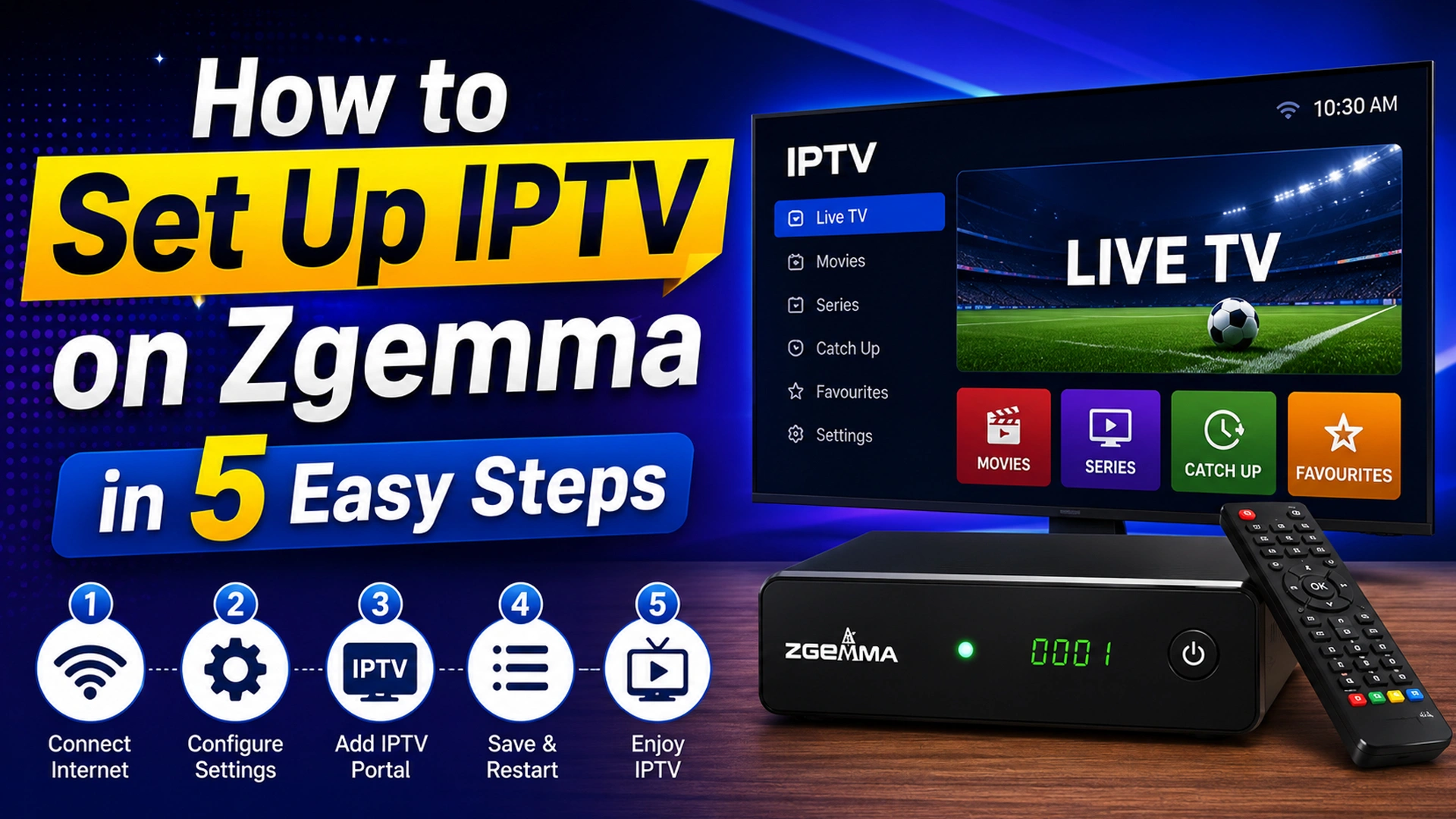
Setting up IPTV on a Zgemma receiver is relatively straightforward once you have the correct playlist or login details from your IPTV provider. Most Zgemma receivers run Enigma2. Hence, it allows IPTV channels to be integrated through compatible plugins, M3U playlists, or provider-supplied Enigma2 configurations.
In this guide, you will learn how to set up IPTV on a Zgemma in five steps, including preparing the receiver, connecting it to the internet, choosing the appropriate IPTV method, loading your playlist, and troubleshooting common problems.
Important: The exact menu names and plugin availability can vary depending on your Zgemma model, Enigma2 image, and software version. Do not install an IPTV plugin or configuration intended for a different receiver or image without first checking compatibility.
What You Need Before Setting Up IPTV on Zgemma
Before starting your Zgemma IPTV installation, have these ready:
| Requirement | What you need |
|---|---|
| Zgemma receiver | Compatible Enigma2 model |
| Internet connection | Ethernet or reliable Wi-Fi |
| Enigma2 image | Compatible and updated image |
| IPTV subscription | A legitimate service with supported credentials |
| Playlist/login | M3U URL, Xtream Codes, or Enigma2 configuration |
| Computer | Useful for network and plugin configuration |
| IPTV plugin | Compatible with your Enigma2 image |
A wired Ethernet connection is generally preferable for a stationary receiver because it provides a more consistent network connection than relying on Wi-Fi.
How to Set Up IPTV on Zgemma in 5 Steps
Step 1: Connect Your Zgemma to the Internet
The first step is making sure your Zgemma receiver can communicate with the IPTV server.
Using the remote, open your receiver’s Network or Network Settings section. The exact location depends on the Enigma2 image installed on your Zgemma.
Connect the receiver using:
- Ethernet cable
- Wi-Fi, if supported
- Your existing home router
After connecting, check the network status and confirm that the receiver has obtained an IP address.
Why a Stable Connection Matters
IPTV streams video continuously, so an unstable connection can result in:
- Buffering
- Channel loading errors
- Frozen video
- Audio interruptions
- Failed playlist updates
If possible, connect the Zgemma directly to your router through Ethernet.
Step 2: Check Your Zgemma Model and Enigma2 Image
Before installing anything, identify your Zgemma model and Enigma2 image.
Zgemma receivers have been released in different hardware generations, and plugin compatibility can vary between models and images.
Common Zgemma models include various H series receivers such as:
- Zgemma H2 series
- Zgemma H5 series
- Zgemma H7 series
- Zgemma H9 series
The setup method is not necessarily identical across every model.
Your Enigma2 image may also affect which plugins are available and where configuration files are stored.
Expert tip: Do not assume that a guide written for one Zgemma model will work exactly the same way on another. Check the receiver model and image before installing an IPTV plugin.
Step 3: Choose Your IPTV Setup Method
This is where many beginners become confused.
There are several ways to bring IPTV channels onto an Enigma2-based Zgemma receiver. The appropriate method depends on what your IPTV provider supplies.
Method 1: M3U Playlist
If your provider gives you an M3U URL, a compatible Enigma2 plugin can convert the playlist into channel groups or bouquets.
Tools such as E2m3u2bouquet are commonly used for this purpose. Enigma2 IPTV guides also document M3U to bouquet workflows for Zgemma and other Enigma2 receivers.
Method 2: Xtream Codes
Some IPTV providers supply:
- Server URL
- Username
- Password
If your installed plugin supports the Xtream Codes API, you can enter these credentials instead of manually entering a long M3U URL.
Method 3: Provider Supplied Enigma2 Configuration
Some IPTV service providers provide a dedicated Enigma2 script or configuration method.
In this situation, follow the provider’s instructions rather than trying to convert the credentials yourself. Enigma2 IPTV setup guides show that Zgemma receivers can be configured through receiver-specific files and scripts.
Best approach: Ask your provider which method they officially support for Zgemma or Enigma2 before installing anything.
Step 4: Install a Compatible IPTV Plugin and Load Your Playlist
Once you know which connection method your service supports, install the appropriate Enigma2 IPTV plugin.
The exact installation process varies by image and plugin. In many Enigma2 environments, plugins can be accessed through the receiver’s plugin browser. Other setups may require transferring files to the receiver over your local network.
For an M3U-based setup, the general process is:
Install compatible plugin → Open plugin settings → Add M3U playlist → Enter playlist URL → Save → Update/refresh → Generate bouquets
After the playlist has been processed, your IPTV channels should appear as organized bouquets within the Enigma2 interface.
An older but still illustrative Zgemma setup workflow uses FTP to transfer bouquet files into the /etc/enigma2 directory before restarting the receiver.
What Is an IPTV Bouquet?
An IPTV bouquet is simply a group of channels organized into a category.
For example:
IPTV → UK → USA → Sports → Movies → News → Kids → International
This is much easier to navigate than putting every IPTV channel into one enormous list.
Step 5: Add EPG and Test Your IPTV Channels
Once your channels are available, the final step is to configure the Electronic Program Guide (EPG) if your IPTV service provides compatible EPG data.
An EPG can display:
- Current program
- Next program
- Program schedule
- Channel information
- Program descriptions
After updating the EPG, test several channels rather than checking only one.
Test These Things
- Live TV: Check whether channels start quickly.
- HD and 4K streams: Test higher resolution channels if your Zgemma model supports them.
- Sports: If sports are important to you, test a live event during a busy period.
- EPG: Check whether program information matches the actual broadcast.
- VOD: If your setup supports movies or series, test whether those sections load correctly.
- Channel switching: Move between several channels to check loading speed and stability.
How to Fix IPTV Not Working on Zgemma
If your IPTV channels do not load, work through these checks in order.
Check Your Internet Connection
Confirm that the Zgemma has a working internet connection. Try another online function on the receiver before assuming the IPTV service is responsible.
Verify Your IPTV Credentials
A single character error in an M3U URL, username, password, or server address can prevent authentication.
Never share your complete M3U URL publicly because it may contain your account credentials.
Refresh the Playlist
If channels have disappeared, update or reload the playlist through your IPTV plugin.
Update the EPG
If channels work but program information is missing, the problem may be related to the EPG source rather than the IPTV stream.
Check Plugin Compatibility
A plugin designed for a different Enigma2 image or software version may not work correctly.
Test Ethernet
If you are using Wi-Fi, temporarily connect the Zgemma using Ethernet. If the problem disappears, your wireless connection may be the weak point.
Check the IPTV Server
If only one provider’s channels fail while other internet functions work normally, contact the provider and ask whether the server or account is experiencing an issue.
Can You Use IPTV and Satellite Channels on the Same Zgemma?
Yes, one of the useful features of an Enigma2 receiver is that IPTV channels can be organized alongside traditional satellite or terrestrial channels, depending on the receiver hardware and configuration.
This means you can potentially have:
Satellite TV + IPTV bouquets + EPG + recordings
within the same receiver interface.
The exact functionality depends on your Zgemma model, tuner configuration, Enigma2 image, plugin, and IPTV service.
How to Improve IPTV Performance on Zgemma
For a smoother IPTV experience:
- Use Ethernet where practical
- Keep the Enigma2 image and compatible plugins updated
- Avoid unnecessarily huge playlists
- Remove channels you never watch
- Keep your EPG data organized
- Test streams at different times of day
- Check your network before blaming the IPTV provider
- Use only IPTV services authorized to distribute their content
A useful diagnostic rule is simple:
- One channel buffering → potentially channel or server issue
- Every channel buffering → investigate your network, receiver, or playlist configuration first
- Channels work, but EPG does not → check the EPG configuration
This approach can save considerable troubleshooting time.
Frequently Asked Questions
-
Can I install IPTV directly on a Zgemma receiver?
Yes. Zgemma receivers running compatible Enigma2 software can be configured for IPTV using supported plugins, M3U playlists, Xtream Codes, or provider-supplied Enigma2 configurations.
-
What IPTV format does Zgemma use?
There is no single IPTV format for every Zgemma receiver. Depending on the plugin and service, you may use an M3U playlist, Xtream Codes credentials, or an Enigma2-specific configuration.
-
Do I need an IPTV subscription for Zgemma?
You need a legitimate source of IPTV content if you want to stream subscription-based live channels. The Zgemma receiver itself does not provide paid IPTV channels.
-
Can I use an M3U playlist on Zgemma?
Yes, compatible Enigma2 plugins can import M3U playlists and convert their channels into organized bouquets.
-
Why is my IPTV buffering on Zgemma?
Buffering can be caused by several factors, including an unstable internet connection, Wi-Fi interference, network congestion, overloaded IPTV servers, incorrect stream settings, or receiver limitations.
-
Can I add EPG to IPTV on Zgemma?
Yes, if your IPTV service supplies compatible EPG data and your chosen Enigma2 plugin supports it. EPG functionality varies by plugin and provider.
-
Is Zgemma good for IPTV?
Zgemma can be a capable IPTV platform for users who want IPTV integrated with an Enigma2 receiver, particularly when they also use satellite or terrestrial TV. However, setup is more technical than using a dedicated IPTV application on Android TV or Fire TV.
Final Verdict
Setting up IPTV on Zgemma can be completed in five basic stages: connect the receiver, check the Enigma2 environment, choose a compatible IPTV method, load your playlist or credentials, and configure the EPG and channels.
The most important part is choosing a setup method that matches your Zgemma model, Enigma2 image, IPTV plugin, and provider credentials. Once configured correctly, IPTV bouquets can provide a much more organized viewing experience than manually searching through a large playlist.
Research on IPTV systems also highlights that factors such as network bandwidth, quality of service, protocols, and compatibility remain important to reliable IPTV delivery.
Your point of view caught my eye and was very interesting. Thanks. I have a question for you.
Your point of view caught my eye and was very interesting. Thanks. I have a question for you.
Thank you for your sharing. I am worried that I lack creative ideas. It is your article that makes me full of hope. Thank you. But, I have a question, can you help me?
Can you be more specific about the content of your article? After reading it, I still have some doubts. Hope you can help me.
Your article helped me a lot, is there any more related content? Thanks!
Your point of view caught my eye and was very interesting. Thanks. I have a question for you.