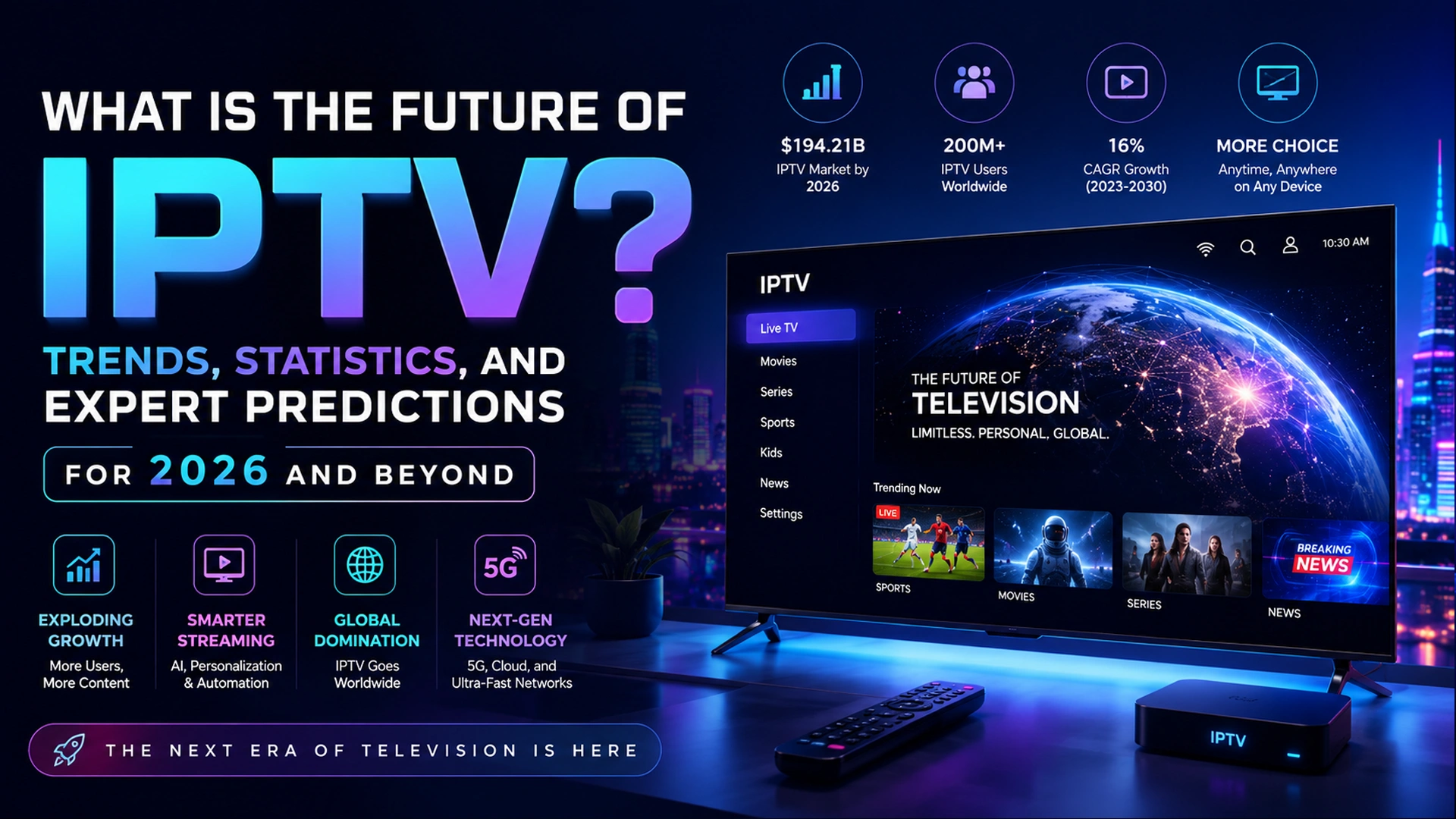
Television is moving away from traditional broadcast models toward internet-based delivery, and IPTV is an important part of that transition. Faster broadband, fiber networks, 5G, cloud platforms, connected TVs, artificial intelligence, and personalized viewing are changing how television content is delivered and consumed.
So, what is the future of IPTV?
The short answer is that IPTV is likely to become more flexible, cloud-based, personalized, and closely integrated with other digital entertainment platforms. However, its growth will depend on network infrastructure, content licensing, cybersecurity, consumer demand, and competition from OTT streaming services.
What Is IPTV?
IPTV, or Internet Protocol Television, delivers television content through IP networks rather than traditional terrestrial, satellite, or cable transmission methods.
Depending on the network architecture, IPTV can deliver live television, video on demand, time-shifted programming, and other interactive services.
A key distinction is that traditional managed IPTV is often delivered through an operator’s controlled network, while OTT services such as Netflix and YouTube generally deliver video over the public internet.
The two technologies are increasingly overlapping from a consumer’s perspective, particularly as smart TVs and streaming devices become more common.
Is IPTV Still Growing?
The broader market for internet-delivered television and video continues to expand as households adopt faster broadband connections, connected TVs, and streaming services.
Industry forecasts vary considerably because research companies define the IPTV market differently. Some measure operator IPTV subscriptions, while others include broader internet television or OTT-related segments.
This is why market-size estimates should be treated as forecasts rather than guaranteed outcomes.
Broadband Is a Major Driver
One of the strongest factors supporting IPTV is broadband availability.
According to Statista, more than 5.56 billion people were using the internet globally in 2025, representing roughly three-quarters of the world’s population, based on current internet usage data.
As broadband and fiber networks expand, delivering high-quality live television over IP networks becomes increasingly practical.
7 Major Trends Shaping the Future of IPTV
1. IPTV Will Become More Cloud-Based
Traditional television infrastructure increasingly relies on physical equipment and dedicated distribution systems. Modern IPTV platforms can move more functions into cloud environments.
Cloud technology can help operators manage:
- Channel distribution
- Video processing
- Content storage
- VOD libraries
- Subscriber accounts
- Analytics
- Digital rights management
- Multi-device streaming
This makes IPTV platforms easier to scale when subscriber demand changes.
Expert advice: IPTV providers should prioritize scalable cloud architecture rather than building systems that only work efficiently at today’s subscriber volume.
2. AI Will Make IPTV More Personalized
Artificial intelligence is likely to become one of the most important developments in IPTV.
Instead of showing every subscriber the same content recommendations, AI systems can analyze viewing behavior and suggest programs based on individual interests.
Future IPTV platforms could use AI for:
- Personalized recommendations
- Automatic content categorization
- Voice-based searches
- Predictive recommendations
- Automated subtitles
- Content tagging
- Customer support
- Detection of unusual account activity
For example, someone who frequently watches Premier League matches could automatically receive recommendations for similar sports programming. They don’t need to manually search through hundreds of channels.
3. 4K and Higher-Quality Streaming Will Become More Common
HD streaming is already mainstream, while 4K content continues to expand.
Higher-resolution video requires more bandwidth and efficient compression technology. As fiber, 5G, Wi-Fi 6, and newer network technologies become more widespread, delivering high-quality video should become easier for many households.
However, 4K availability does not automatically mean better IPTV quality.
Actual performance also depends on:
- Source quality
- Encoding
- Bitrate
- Network congestion
- Device capability
- Display resolution
- Server infrastructure
A well-encoded Full HD stream can look better than a poorly encoded 4K stream.
4. 5G Could Expand Mobile IPTV
5G networks provide higher capacity and lower latency than earlier generations of mobile networks in suitable conditions.
This creates opportunities for mobile live television, sports streaming, and other real-time video services.
Instead of television being tied to a living-room screen, users can increasingly watch the same content across:
- Smartphones
- Tablets
- Smart TVs
- Cars
- Laptops
- Streaming boxes
The important point is that 5G complements IPTV rather than replacing broadband IPTV. Fixed fiber connections will remain important for households that consume large amounts of high-resolution video.
5. IPTV and OTT Will Continue to Converge
The distinction between IPTV and OTT is becoming less obvious to consumers.
A modern Smart TV may contain:
- Operator IPTV
- Netflix
- YouTube
- Disney+
- Prime Video
- Live TV applications
- FAST channels
- Personal media libraries
Users care less about the underlying delivery technology and more about whether they can find and watch their desired content easily.
This means future television platforms are likely to focus on unified search, recommendations, profiles, and content discovery rather than keeping every service completely separate.
6. FAST Channels Will Influence Internet Television
FAST stands for Free Ad-Supported Streaming Television.
FAST platforms provide scheduled channels over the internet and generally generate revenue through advertising rather than traditional subscriptions.
This model combines some characteristics of traditional television with streaming distribution.
For IPTV operators, FAST creates another competitive model alongside:
- Subscription TV
- Pay-per-view
- Video on demand
- Traditional broadcast
- OTT subscriptions
The result could be a television environment where viewers move between paid, free, live, and on-demand content within the same interface.
7. Multi-Screen Viewing Will Become the Standard
Future IPTV platforms will increasingly treat the subscriber’s account as the central point rather than a single television.
A viewer might begin watching a football match on a Smart TV, continue on a smartphone, and finish on a tablet.
Features likely to become more important include:
- Cross-device synchronization
- Continue Watching
- Cloud DVR
- Multiple user profiles
- Parental controls
- Personalized recommendations
- Multi-device subscriptions
This makes IPTV more similar to the broader streaming ecosystem.
The Role of Cloud DVR in Future IPTV
Cloud DVR is another area likely to become increasingly important.
Instead of storing recordings on a physical set-top box, cloud DVR allows recordings to be stored remotely and accessed through supported devices.
Future IPTV platforms could combine:
Live TV + cloud DVR + catch-up TV + VOD + personalized recommendations
into one interface.
For users, this removes much of the distinction between watching something live and watching it later.
Will IPTV Replace Cable and Satellite TV?
Not completely, at least not in the near future.
IPTV and internet-based television are likely to continue taking market share from traditional distribution methods, particularly where high-speed broadband is widely available.
However, cable and satellite remain important in many markets because of:
- Existing infrastructure
- Rural coverage
- Bundled services
- Sports rights
- Local broadcasting
- Established customer bases
The more realistic prediction is continued coexistence and gradual migration toward IP-based delivery, rather than an overnight replacement of cable and satellite.
What Could Slow IPTV Growth?
The future of IPTV is promising, but several challenges remain.
Content Licensing
Premium sports and entertainment rights are expensive. The availability of legitimate IPTV channels depends heavily on licensing agreements.
Network Congestion
High-quality live video requires consistent bandwidth. Congestion can reduce streaming quality even when a household has a fast internet connection.
Cybersecurity
IPTV platforms handle subscriber accounts, payment information, viewing data, and sometimes sensitive authentication credentials.
Operators therefore need strong:
- Encryption
- Authentication
- Access controls
- Monitoring
- Software updates
- Data protection practices
Piracy and Unlicensed Services
The IPTV industry also faces a major challenge from unauthorized distribution.
The technology itself is not illegal. The legality depends on the content being distributed and whether the distributor has the necessary rights.
Cheap services advertising thousands of premium channels without transparent licensing can create legal, security, and reliability risks for consumers.
What Will IPTV Look Like in 2030?
No one can predict the television industry with certainty, but several developments are reasonably likely.
By 2030, IPTV and internet television could offer:
- AI-powered content discovery
- Highly personalized home screens
- More 4K and potentially 8K content
- Cloud-based recording
- Seamless multi-device playback
- Voice-controlled navigation
- More interactive live programming
- Greater integration with Smart TVs
- AI-generated subtitles and translations
- More targeted advertising
- Unified access to live, on-demand, and FAST channels
The biggest change may not be the streaming technology itself. It may be the way television content is organized around the individual viewer.
Expert Advice: What IPTV Providers Should Focus On
From a technology and consumer perspective, IPTV providers should avoid competing only on channel quantity.
A stronger long-term strategy is to invest in:
- Reliable infrastructure: Consistent uptime and predictable performance matter more than a huge channel count.
- Content quality: Stable HD and 4K streams with accurate metadata create a better viewing experience.
- User experience: Fast search, useful recommendations, clean navigation, and reliable EPG data can differentiate a service.
- Security: Strong authentication and responsible handling of subscriber information are essential.
- Device compatibility: Viewers increasingly expect their subscription to work across multiple screens.
- Transparent licensing: Clearly explaining content rights helps establish consumer trust and protects the service’s long-term reputation.
What Should IPTV Users Look For in the Future?
Consumers should also change how they evaluate IPTV services.
Instead of asking only “How many channels do I get?”, consider:
- Is the service properly licensed?
- Does it work reliably during peak viewing periods?
- Does it support your devices?
- Is the EPG accurate?
- Does it offer useful VOD functionality?
- Are account and payment details handled securely?
- Does the provider offer responsive customer support?
- Are subscription and cancellation terms clear?
A smaller, reliable and properly licensed service can provide a better experience than a service advertising an enormous channel list.
Frequently Asked Questions
-
What is the future of IPTV?
The future of IPTV is likely to involve cloud infrastructure, AI-powered personalization, higher-resolution video, multi-device streaming, cloud DVR, and closer integration with OTT and FAST platforms.
-
Will IPTV replace cable TV?
IPTV and other internet-based television services are likely to continue gaining ground, but cable and satellite will not disappear immediately. Availability, infrastructure, pricing, and content rights will influence the transition.
-
Will IPTV use AI?
Yes. AI can improve content recommendations, voice search, subtitles, customer support, content classification, and other IPTV functions.
-
Will 5G improve IPTV?
5G can improve mobile and wireless video delivery by providing greater network capacity and lower latency in suitable conditions. However, fixed broadband and fiber will remain important for home IPTV.
-
Is IPTV technology legal?
Yes. IPTV is a method of delivering video over IP networks. However, individual IPTV services must have appropriate rights to distribute the content they provide.
-
Is IPTV better than cable?
It depends on the service and location. IPTV can offer greater flexibility, multi-device access, VOD, cloud features, and interactive functionality, while cable may still provide advantages in certain markets.
-
What is the biggest challenge for IPTV?
Content licensing, network reliability, cybersecurity, piracy, and competition from OTT platforms are among the industry’s biggest challenges.
Final Verdict: What Does the Future Hold for IPTV?
IPTV is unlikely to disappear. Instead, it is likely to become increasingly integrated into the wider internet television ecosystem.
The next stage of IPTV will be less about simply delivering television channels over an IP network. Moreover, it is about creating a personalized entertainment platform that combines live TV, VOD, cloud DVR, AI recommendations, multi-device viewing, FAST channels, and interactive features.
For consumers, that means more choice and flexibility. For providers, it means that reliable infrastructure, legitimate content, strong security, and a good user experience matter.
The technology will continue to evolve, but one principle is unlikely to change: viewers want reliable access to the content they care about, on the device they choose, whenever they want it.
Your point of view caught my eye and was very interesting. Thanks. I have a question for you.
Your article helped me a lot, is there any more related content? Thanks!
Thanks for sharing. I read many of your blog posts, cool, your blog is very good.
Thank you for your sharing. I am worried that I lack creative ideas. It is your article that makes me full of hope. Thank you. But, I have a question, can you help me?
Can you be more specific about the content of your article? After reading it, I still have some doubts. Hope you can help me.